Choose an animal, give it a small problem and ask what happens next. A child can answer aloud, draw another scene or dictate one sentence. Use a coloring page or their own drawing; no special story cards or new book are required.
A finished picture does not have to be the end of an activity. It can be the beginning of a story. A purple giraffe might be looking for a lost hat, or a sleepy animal might discover a tiny door. The color choices are part of an invented world, and the child can decide what happens there.
These prompts are original activity ideas from Little Wonder Club. They are designed to be adaptable for families with children ages 4–8, without requiring independent reading or a polished written story. Try one prompt rather than treating the list as twelve tasks.
Set up a story in four small steps
- Point to the character. Ask, “Does this animal have a name?” A real species name and an invented character name can coexist.
- Pick one situation. Read a prompt from the list below. Offer two choices if a completely open question stalls the conversation.
- Ask for the next action. “What does your animal try?” is enough. You do not need a long plot.
- Let the child choose an ending. Record their words on separate paper or leave the story spoken.
For a child who enjoys talking, be the listener. For a child who prefers drawing, invite a second picture. If they would rather continue coloring quietly, put the prompts aside. This is an optional extension, not a test of imagination.
12 prompts, with a useful follow-up question
| Story starter | Ask next |
|---|---|
| 1. Your animal finds a hat that is much too big. | Who might it belong to, and how could they find out? |
| 2. A tiny door appears at the bottom of a tree. | Does your animal knock, leave a note or walk past? |
| 3. The animal wants to give a friend a surprise. | What can it make with what is already nearby? |
| 4. A cloud looks exactly like the animal's favorite thing. | What happens when the cloud changes shape? |
| 5. The animal has drawn a map with one missing place. | What would you add to finish the map? |
| 6. A leaf becomes a pretend ticket for a journey. | Where does the ticket take the animal? |
| 7. Two friends want different colors for their shared sign. | How can both ideas become part of the design? |
| 8. The animal hears a mysterious tapping sound. | What ordinary thing could be making it? |
| 9. A small visitor asks for directions. | Which landmark would your animal describe first? |
| 10. The animal plans a picnic, but one thing is missing. | Can it change the plan instead of canceling it? |
| 11. The animal's shadow seems to wave back. | Is this a game, a dream or a magical story? |
| 12. The animal finds a blank postcard. | Who receives it, and what does it say? |
A worked example with our giraffe page
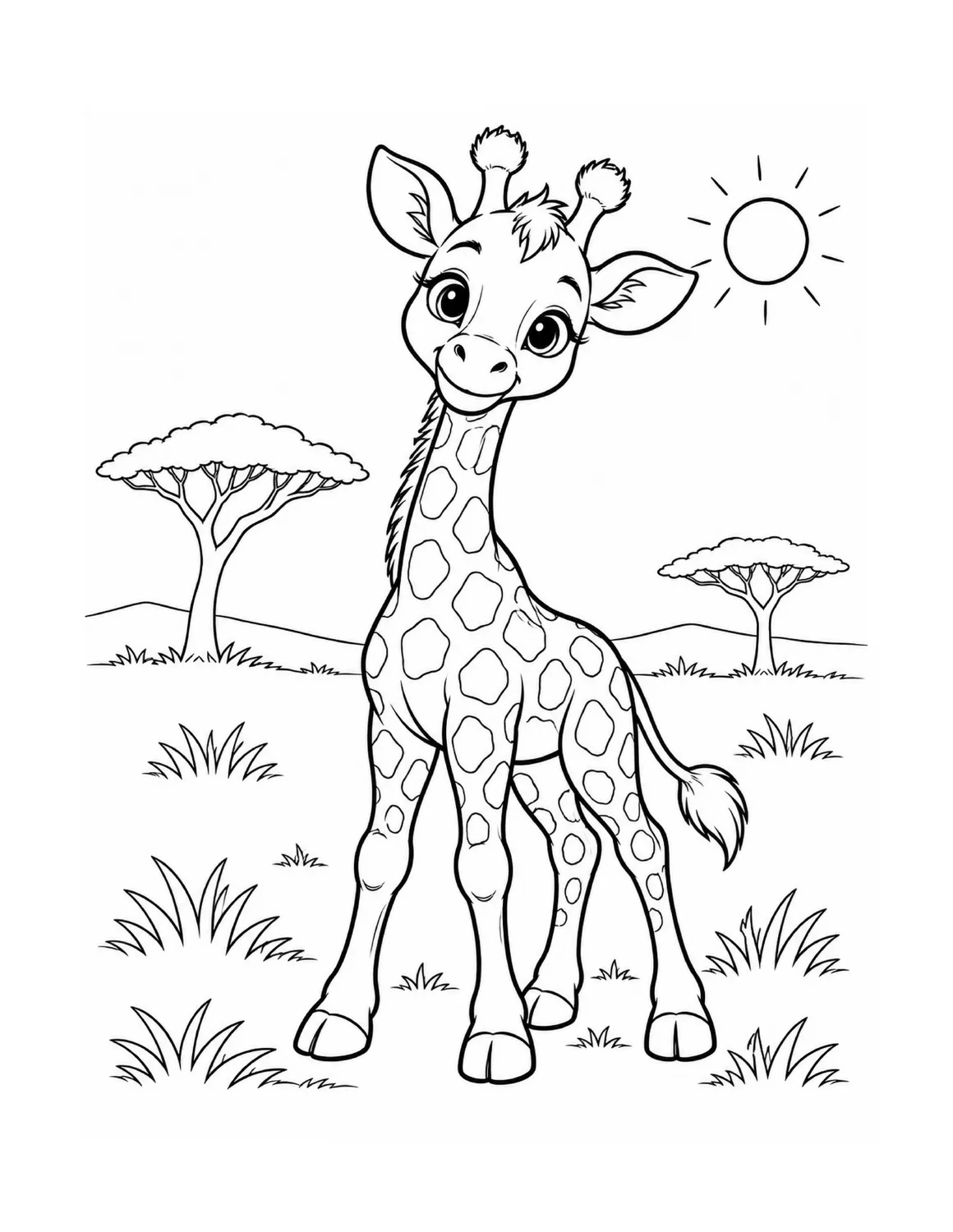
Choose prompt five: the unfinished map. The giraffe calf becomes “Milo,” and the two trees on the page become landmarks. An adult might ask, “Milo drew these trees on the map. What is missing?” The child could choose a pond, a friend's house or something entirely imaginary.
A three-sentence version might be: “Milo wanted to visit the little pond. His map showed the trees but not the path between them. He drew a blue dotted line and invited his friend to follow it.” That is one possible ending, not an answer to copy. The child can decide that the map leads to the moon instead.
To extend the idea, draw the map on separate paper. Use two circles for trees and a line for the route. The child can make marks or explain the drawing aloud; they do not need to write labels. This adds a second activity without altering or cutting the book page.
Keep animal facts and imaginary stories separate
Say, “In our story, the giraffe sends a postcard,” rather than presenting invented actions as real behavior. If the child asks a factual question, pause and check a reliable animal reference. A printed fact can start a conversation, while the story remains a place for imaginative choices.
You can use the short introductions in our book as a separate reading moment. There is no need to make the invented plot prove that the child remembered a fact.
A free planner to save for later
Our one-page planner has space for a character, a place, a problem, a next step and an ending. It contains writing and drawing spaces rather than copied book artwork. An adult can write dictated words, and the page also works with an original animal drawing.
Open the free printable story planner
No email or signup is required. Open it in your browser and choose Print, or Save as PDF. You can use it at home or in your classroom and print copies for your own group; do not sell or repackage the file.
Want a collection of animal starting points?
Baby Animals brings together 40 baby animals with coloring illustrations and short facts in an English paperback for ages 4–8. Preview the inside pages to decide whether it fits your family.
Check the Baby Animals paperback on AmazonQuestions about the activity
Does my child need to write independently?
No. Spoken answers, drawings and adult dictation all work. Use the planner only if it helps your particular session.
Can we tell a story before coloring?
Yes. A story can inspire the colors, or the colors can inspire a story afterward. Neither order is required.
What if the child answers with just one word?
Accept the answer. Offer one follow-up choice or return to coloring; there is no minimum story length.
Written for Little Wonder Club using original prompts and a supplied book preview. These are suggested family activities, not claims of proven educational outcomes. For the factual side, explore our animal facts and coloring guide.