Baby animal coloring books · Ages 4–8 · Parent guide
The Complete Baby Animal Coloring Book Guide for Kids Ages 4–8
A practical, parent-friendly guide to choosing a baby animal coloring book for kids ages 4–8, with real interior-preview advice, screen-free activity ideas, animal-fact prompts, travel uses, gift ideas, and a detailed look inside Wild Little Wonders: Baby Animals.
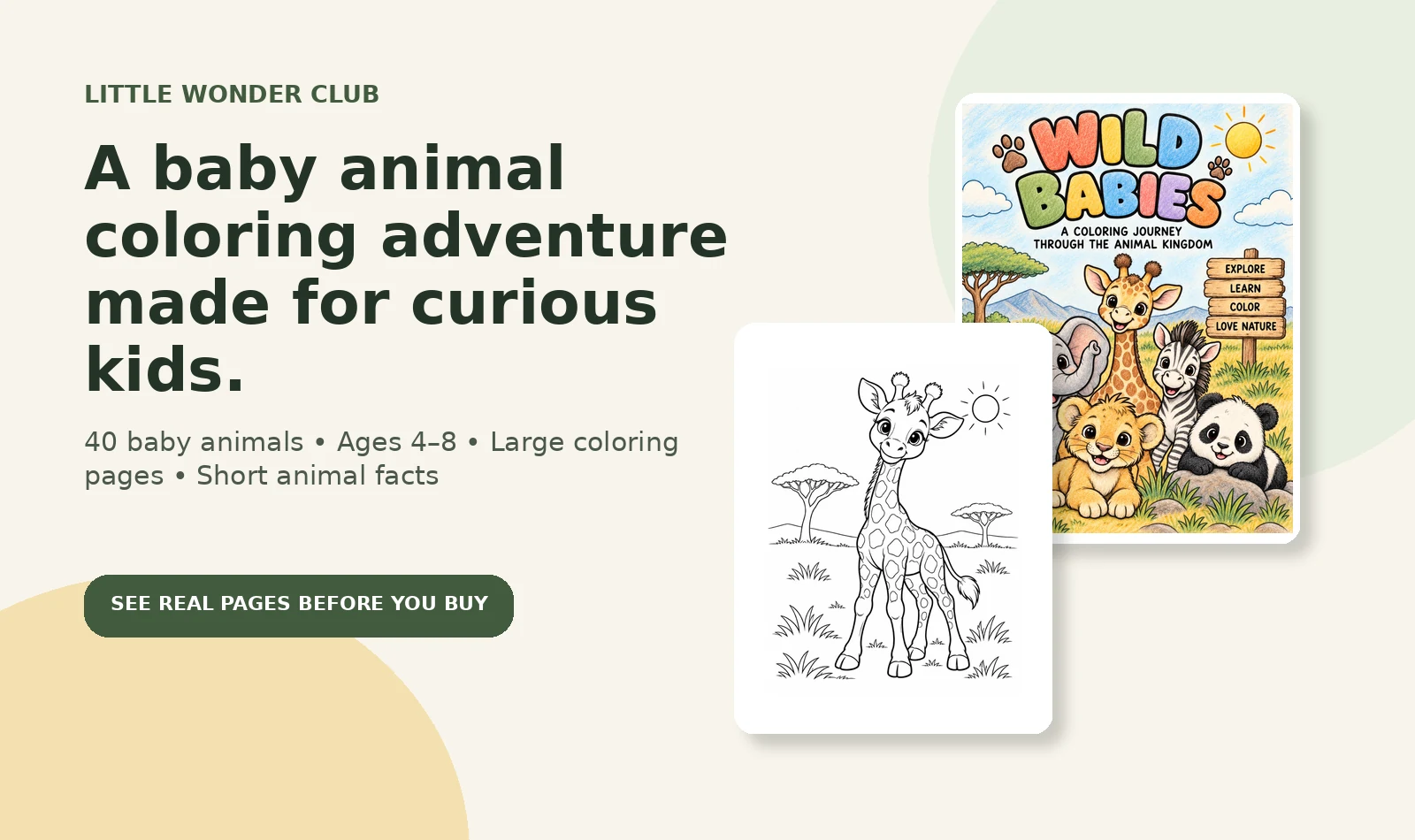
A good baby animal coloring book for ages 4–8 should have recognizable animals, clear focal points, comfortable coloring spaces, enough detail to stay interesting, and enough variety to support many separate coloring sessions. Wild Little Wonders: Baby Animals combines 40 baby animals, large black-and-white coloring illustrations, and short animal introductions in an English paperback created for this age range.
What Is a Baby Animal Coloring Book?
A baby animal coloring book is a children’s activity book built around young animals such as cubs, calves, chicks, foals, pups, joeys, kittens, ducklings, penguin chicks, baby elephants, giraffe calves, lion cubs, panda cubs, and other young animals. For children, the appeal is immediate: the subject is recognizable, friendly, and easy to talk about before a single crayon touches the page.
But not every animal coloring book works equally well for younger children. Some books use tiny patterns, dense decorative backgrounds, or highly detailed line art that feels closer to an adult coloring book. Others are so sparse that children can lose interest after one or two pages. A useful animal coloring book for kids usually sits between those extremes: one clear animal, comfortable coloring spaces, enough background detail to create a scene, and enough variety across the book to make children want to return.
That balance is especially important for families searching for terms like coloring book for kids ages 4–8, cute animal coloring book for kids, easy animal coloring pages, large coloring pages for children, animal coloring book with facts, or screen-free activity book for kids. These searches sound similar, but the underlying needs are different. One family may want big, simple areas for a four-year-old. Another may want animal facts for a seven-year-old. Another may simply want a quiet activity for travel, rainy afternoons, or bedtime wind-down.
The most useful book is therefore not necessarily the one with the most pages or the loudest cover. It is the one whose interior matches the child’s interests, attention span, preferred level of detail, and the way the family expects to use it.
A practical way to judge any children’s coloring book is to ignore the marketing language for a moment and inspect one real interior page. Can the child immediately see what the main subject is? Is there at least one generous area where they could start? Are the smallest shapes still approachable? Does the background add options without taking over the page? If those answers are mostly yes, the book is probably easier to use than a cover alone can tell you.
Why Baby Animals Work So Well as a Coloring Theme
Baby animals have a natural advantage as a children’s coloring theme: they are immediately understandable. A child does not need instructions to recognize a puppy, kitten, giraffe, elephant, panda, penguin, zebra, bird, or rabbit. The animal itself provides the starting point.
That matters because beginning an activity can sometimes be harder than doing the activity. A blank sheet asks the child to invent everything. A recognizable animal page gives them something concrete while still leaving many creative choices open. They can decide what color to use, whether to follow real-world colors, whether to invent patterns, and whether to color the background at all.
Animals also provide visual variety. A zebra introduces stripes. A giraffe introduces patches. A panda introduces bold dark and light areas. A bird introduces feathers. A turtle introduces shell shapes. A lion cub introduces fur and a face with expressive features. This variety helps a multi-animal coloring book feel different from page to page.
The theme also connects easily with conversation. A child may ask what a baby giraffe is called, where penguins live, whether lions sleep a lot, why zebras have stripes, or how large a baby elephant is. Those questions can become optional learning moments without changing the activity into a lesson.
For parents searching for cute animal coloring pages for kids, animal activity books for children, nature coloring books for young kids, preschool animal activities, or kindergarten animal activities, baby animals offer one theme that can support creativity, quiet time, storytelling, and simple curiosity at the same time.
Why Ages 4–8 Is a Useful Range for Animal Coloring Books
The ages from roughly four to eight cover a wide range of interests and abilities. A four-year-old may enjoy filling one large area with a single color and leaving the rest untouched. An eight-year-old may build a complete habitat, invent a story for the animal, add extra scenery, and use the fact page as a conversation starter. Both can use the same picture successfully.
This is why “coloring book for 4 year olds,” “coloring book for 5 year olds,” “coloring book for 6 year olds,” “coloring book for 7 year olds,” and “coloring book for 8 year olds” are overlapping rather than completely separate categories. Age labels help narrow the search, but children within the same age can prefer very different levels of detail.
For younger children, the most useful part of the page may be the main animal. They may not care about every leaf, line, or background object. For older children, those same details can create a second layer of interest. A page that supports both behaviors has a longer useful life inside the suggested age range.
Age recommendations should therefore be treated as guidance, not as a rule. The child’s interests, patience, preferred tools, and comfort with small shapes matter too. A four-year-old who loves animals may spend longer with a giraffe page than an eight-year-old who is not interested in animals at all.
When comparing books, ask whether the interior gives the child permission to stop. A good coloring page does not require every section to be completed. Leaving the sky white, skipping the grass, or coloring only the animal is still a complete creative session. That flexibility is particularly useful for ages 4–8 because attention and energy can vary dramatically from day to day.
What to Look for Before Buying an Animal Coloring Book for Kids
There is no single “best animal coloring book” for every child, but there are practical qualities that make a book easier to evaluate. Before buying, focus on the interior rather than the cover.
1. Real interior previews
A cheerful cover can make two very different coloring books look equally appropriate. One may contain large animal shapes and open spaces; another may use tiny patterns and crowded scenery. If a publisher shows real inside pages, use them. Interior previews are more useful than adjectives like “easy,” “simple,” “fun,” “bold,” or “perfect for kids.”
2. A clear main subject
Younger children often benefit from a page with one obvious focal point. A baby elephant, lion cub, giraffe calf, puppy, kitten, panda, zebra, or penguin gives the child an immediate place to start. Backgrounds can add interest, but the animal should remain easy to identify.
3. Comfortable coloring areas
Look at the smallest shapes on the page, not only the thick outer outline. A page can have bold outlines but still contain tiny fur marks, leaves, grass, feathers, or decorative patterns. The important question is whether the child can find at least one comfortable area to begin.
4. Useful background detail
A background can give the child more choices: sky, grass, trees, rocks, flowers, water, clouds, or habitat clues. But too much detail can make the page feel crowded. The best balance depends on the child. Some children want a single isolated animal; others enjoy building a whole scene.
5. Variety across the book
A larger animal collection gives children choices. One day they may want a giraffe. Another day they may choose a panda, lion, bird, rabbit, farm animal, jungle animal, or sea-related animal. A book that supports choice can become a repeatable activity instead of a one-session novelty.
6. Age-appropriate text
If the book includes animal information, short text usually works better than long paragraphs for ages 4–8. The text should be optional: a child should be able to color even if they do not want to read, while an adult or older child can use the information as a conversation starter.
7. A practical physical format
Large-format children’s coloring books give more room for broad areas and visible details. A format around 8.5 × 11 inches is familiar for home tables, desks, and travel bags while still offering a generous coloring area.
8. Honest format information
Do not assume the pages are perforated, removable, marker-proof, single-sided, or printed on a particular paper weight unless the publisher specifically says so. A cropped preview cannot answer every physical-format question. If markers matter to your family, check the listing or use crayons and colored pencils as the safer starting point.
9. A theme the child actually likes
A technically excellent book about a theme the child does not care about may stay closed. Interest matters. For children who love animals, a baby animal theme creates many entry points: pets, farm animals, wildlife, jungle animals, birds, ocean animals, and more.
Inside Wild Little Wonders: Baby Animals
Wild Little Wonders: Baby Animals is an English-language paperback designed around 40 baby animals. The interior is black and white for coloring, and the book pairs animal-themed coloring illustrations with short animal introductions or facts. It is intended primarily for kids ages 4–8.
The book is meant to be used flexibly. A child can color one page and stop. They can skip around. They can choose the animal based on mood. An adult can read the short animal information aloud, or the child can ignore the text and focus entirely on coloring. There is no requirement to complete the book from beginning to end.
For families comparing baby animal coloring books on Amazon, animal coloring books with facts, large print coloring books for kids, or easy coloring books for ages 4–8, the most useful next step is to look at the real interior. The page previews show the balance between the main animal, smaller markings, and background elements more clearly than a product description can.
The book contains 88 pages in total, but “88 pages” does not mean 88 separate coloring designs. Total page count includes all printed page positions, such as title or introduction material and animal information. The separate animal count is 40. When comparing coloring books, it is useful to keep “total pages” and “number of coloring illustrations” separate rather than treating them as the same number.
The real interior preview is also useful for judging tools. Broad body shapes can be comfortable with crayons. Smaller markings may be easier with colored pencils. If you intend to use markers, test cautiously and protect the next page unless the listing specifically verifies marker compatibility.
See the actual pages before deciding
Open the real interior previews and judge the illustration size, amount of detail, background complexity, and page style for yourself.
Preview Baby Animals Check current Amazon listingBaby Animal Coloring as a Screen-Free Activity for Kids
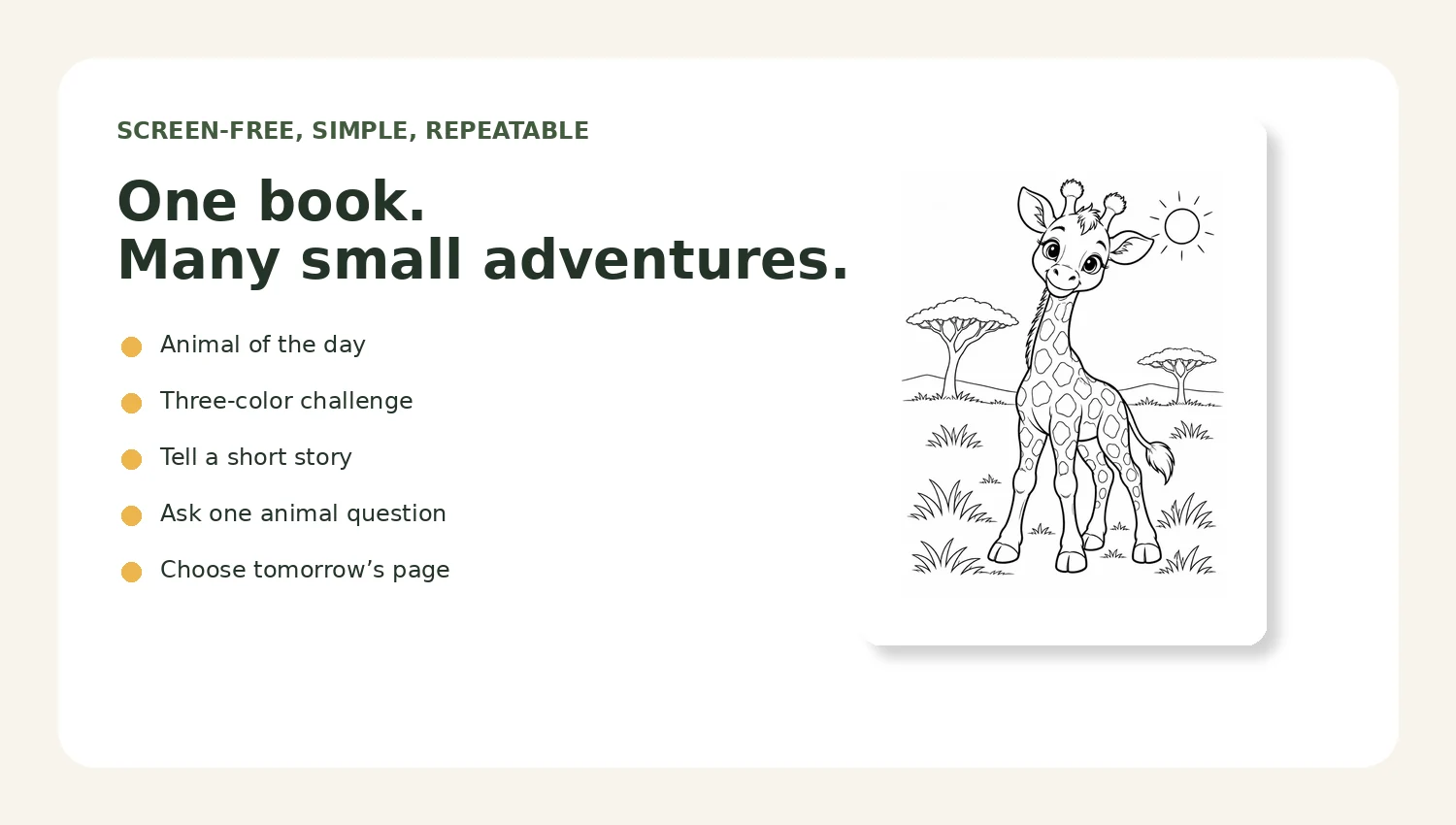
Parents searching for screen-free activities for kids ages 4–8 often find activities that require planning, special supplies, subscriptions, or complicated setup. Coloring is simpler. A child needs a book, crayons or colored pencils, and a surface to work on.
That low setup makes animal coloring useful for after-school quiet time, rainy-day indoor activities, weekend creative time, restaurant waiting, road trips, flights, visits to grandparents, bedtime wind-down, classroom choice time, homeschool breaks, and short five-minute creative sessions.
The session does not need to be long. A child may color for five minutes and return later. That flexibility matters because a coloring book should not turn into another task that must be “finished.”
20 easy ways to use a baby animal coloring book
- Animal of the day: Let the child flip through and choose one animal without adult direction.
- Three-color challenge: Pick only three colors and see how the picture changes.
- Real vs. imaginary colors: Color one area realistically and another creatively.
- Name the animal: Give the pictured animal a character name.
- Add a habitat: Draw extra plants, water, clouds, rocks, or trees on separate paper or around the scene if space allows.
- Tell a short story: Ask what happened immediately before or after the picture.
- Ask one animal question: Choose a single thing to look up later.
- Color together: Parent and child can take turns choosing colors or areas.
- Draw a second version: After coloring, make an original drawing of the same animal.
- Choose tomorrow’s page: End by bookmarking the next animal.
- Warm-color page: Use only reds, oranges, yellows, and warm neutrals.
- Cool-color page: Use blues, greens, purples, and cool neutrals.
- Pattern experiment: Add dots, stripes, stars, or simple shapes to one large area.
- Weather story: Decide whether the animal’s day is sunny, rainy, snowy, or windy.
- Friendship prompt: Ask which other animal in the book might be this animal’s friend.
- Sound prompt: Invent the sound the animal might hear in its habitat.
- Map prompt: Draw a simple path from the animal to a pond, tree, home, or friend.
- One-minute start: Color only one small section to remove the pressure of completing a page.
- Family color vote: Let each person choose one color to include.
- Story ending: After coloring, ask for one sentence describing what happens next.
These ideas overlap with the needs behind searches such as creative activities for kids, easy indoor activities for children, animal activities for preschoolers, kindergarten animal activities, quiet activities for kids, and screen-free activities at home.
Can an Animal Coloring Book Be Educational?
Coloring does not need to become a lesson in order to be worthwhile. A child may simply want to color a giraffe purple or a panda blue. That is enough.
But animal pages naturally create optional learning moments. A parent might ask, “What animal is this?” “Where might it live?” “What do you think it eats?” “Does the baby look like the adult?” or “What do you notice first?” These are open-ended prompts, not tests.
An animal coloring book with facts can make those moments easier because the adult has a small piece of information available on the page. The important part is keeping the fact short enough that it does not overwhelm the coloring activity.
A simple coloring + animal-fact routine
- Let the child choose an animal.
- Read one short fact or introduction aloud.
- Ask one open question.
- Return to coloring.
This approach supports curiosity without turning the book into homework. It also works for children who are not reading independently yet because the adult can handle the text while the child focuses on the picture.
Coloring + storytelling
Animal coloring pages can also become story prompts. Ask the child what the animal’s name is, where it is going, who its friend is, what problem it has, or what happens next. Spoken answers are enough. Writing is optional.
A child who enjoys talking can dictate a story while an adult listens. A child who prefers drawing can make a second picture instead. A child who wants to color quietly can ignore the storytelling prompt entirely. The activity should stay optional.
Keep facts and imagination separate
It can be helpful to say, “In our story, the giraffe sends a postcard,” rather than presenting an invented behavior as a real animal fact. This small distinction lets the child enjoy imaginative play while keeping factual questions open for later checking.
Baby Animal Coloring Ideas by Age
Baby animal coloring books for 4-year-olds
A four-year-old may focus on broad areas and favorite colors. They may leave much of the page white. That is fine. Useful prompts include “Which animal do you want?” and “What color should we start with?” Avoid making neatness the goal. If a page feels busy, suggest just one starting area such as the face, body, sun, or a tree.
Searches like easy coloring book for 4 year old, simple animal coloring pages for preschoolers, and large animal coloring pages for young children often point to this same need: a page with a clear subject and at least one generous area to begin.
Baby animal coloring books for 5-year-olds
Five-year-olds may begin noticing stripes, spots, ears, tails, feathers, grass, trees, and other visual details. They can choose whether to copy real animal colors or invent their own. Short animal facts can be read aloud. A three-color challenge or “real color / silly color” choice can work well.
Animal coloring books for 6-year-olds
Six-year-olds may enjoy planning a color palette, adding patterns, or drawing an extra object around the animal. They can also use a picture as the beginning of a spoken story. If they enjoy writing, one short sentence can be added on separate paper.
Animal coloring books for 7-year-olds
Seven-year-olds may spend more time on smaller areas, background elements, and invented habitats. They may also enjoy reading short animal information independently or asking follow-up questions. This is a good age for combining the coloring page with a simple map, fact card, or story prompt.
Animal coloring books for 8-year-olds
Eight-year-olds can extend the activity with creative writing, fact checking, extra drawings, maps, signs, or a second scene. A simple coloring page can become the beginning of a larger creative project. At this age, some children may also prefer more detailed pages, while others still enjoy broad shapes and quick sessions.
The important point is that age does not determine a single “correct” way to color. Interest and preferred detail vary. A child should be able to use the page at their own level.
How to Choose the Right Coloring Book for a Child Who Loves Animals
When comparing books, use this practical checklist. It turns a vague search for “the best animal coloring book” into a few concrete decisions.
1. Can I see genuine interior pages?
Real previews are more useful than a cover or marketing adjective.
2. Is the main animal easy to identify?
A clear focal point gives younger children an easy place to start.
3. Are the smallest details manageable?
Look at markings, grass, leaves, feathers, fur, and background objects.
4. Is there enough variety?
A collection of different animals can support many separate coloring sessions.
5. Is the text optional?
Facts can add value, but the child should still be able to enjoy the page without reading.
6. Does the format fit your routine?
Think about home tables, travel bags, restaurants, classrooms, and storage.
7. Does the child actually like the theme?
Interest matters more than a generic recommendation list.
8. Does the listing clearly describe the format?
Check page count, book size, language, and whether any special paper or page feature is explicitly claimed.
9. Does the book offer more than one type of use?
A strong book can support coloring, conversation, storytelling, and quiet time without forcing any of them.
10. Can the child stop without feeling unfinished?
Pages that still feel successful when only partly colored are often easier to return to.
Commercial-intent searches this guide helps answer
Parents commonly search for phrases such as best animal coloring book for kids, baby animal coloring book ages 4–8, cute animal coloring book for kids, animal coloring book with facts, easy coloring book for 4 year old, coloring book for 5 year old, coloring book for 6 year old, animal activity book for kids, large coloring book for children, screen-free gift for kids, and gift for a child who loves animals.
Those phrases are useful only when the page actually answers the underlying question. The goal is not to repeat keywords mechanically; it is to cover the decisions parents are really trying to make.
Printable Animal Coloring Pages vs. a Paperback Coloring Book
Free printable animal coloring pages can be useful when you need one quick activity. A bound paperback solves a different problem: it keeps many activities together without requiring a printer, ink, file downloads, or loose-page organization.
| Printable pages | Paperback coloring book |
|---|---|
| Good for one-off activities | Good for repeated use over time |
| Requires printer and paper | Ready to use out of the bag |
| Loose sheets | Bound collection |
| Easy to choose one theme at a time | Many animals available in one place |
| Printing cost depends on home setup | Single purchase price |
| Can be replaced easily if damaged | Keeps finished pages together as a collection |
Neither format is always better. Many families use both. A paperback can be the regular collection, while printables or original drawings fill occasional requests.
When comparing cost, avoid assuming that “free printable” means zero cost. Home printing uses paper and ink, and each family’s setup is different. Similarly, a paperback has a purchase and delivery cost. The more useful question is which format fits the family’s routine.
Why an Animal Coloring Book Works for Travel, Restaurants, and Quiet Time
Travel activities work best when they are easy to pack and easy to begin. A bound coloring book and a small pencil case can be enough for a road trip, flight, train ride, hotel room, restaurant wait, or visit with relatives.
For travel, a physical book also avoids several small setup problems: no printer, no downloaded file, no loose stack of paper, no account login, and no battery. That simplicity is one reason parents search for screen-free travel activities for kids, road trip activities for children, airplane activities for ages 4–8, and quiet restaurant activities for kids.
A child can use the same book differently in different places. At home, they may spend thirty minutes on a detailed page. At a restaurant, they may color only the animal’s face. On a plane, they may choose a page with large areas and save the smaller details for later.
A simple travel coloring kit
- one bound coloring book
- six to twelve crayons or colored pencils
- a small zip pouch
- a piece of scrap paper for testing colors or protecting pages
- optional stickers or blank paper for extra drawing
Keep the kit small enough that the adult is willing to carry it. A “perfect” travel activity that requires a large box of supplies is less likely to be used than a simple one that can stay in the bag.
Is a Baby Animal Coloring Book a Good Gift for Kids?
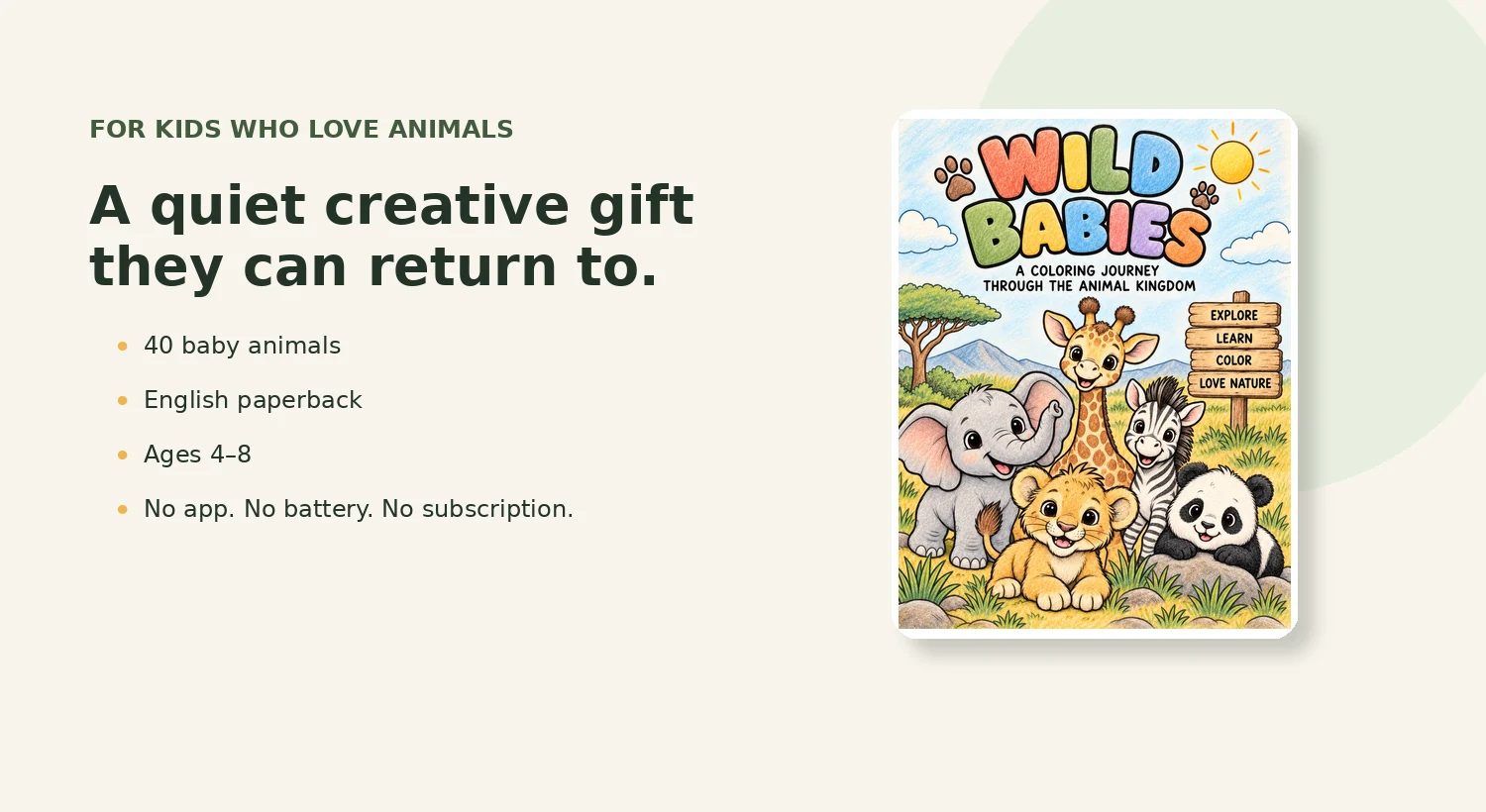
A baby animal coloring book can be a practical gift for children who already enjoy animals, drawing, coloring, nature, activity books, or quiet creative play. It can work for birthdays, holidays, Easter baskets, travel surprises, classroom rewards, and small everyday gifts.
It is especially easy to evaluate as a gift when real interior previews are available. Instead of relying on a generic “best gifts for kids” list, you can look at the page complexity and ask whether the child would actually enjoy the animals and style.
For someone shopping for a gift for a 4 year old who loves animals, gift for a 5 year old who likes coloring, animal gift for a 6 year old, creative gift for a 7 year old, or screen-free gift for kids ages 4–8, a paperback coloring book is a relatively simple option that does not require a device or ongoing subscription.
Good gift situations
- birthday gifts for animal-loving children
- Christmas stocking or holiday add-on gifts
- Easter basket activity books
- travel-day surprises
- small classroom or homeschool rewards
- quiet-time activity gifts
- gifts from grandparents or relatives
- creative gifts that do not require batteries
Before buying, check the real interior and current Amazon listing so the format, price, and delivery match the recipient’s needs.
Popular Questions Parents Ask About Animal Coloring Books
What is a good animal coloring book for kids ages 4 to 8?
A good animal coloring book for ages 4–8 has recognizable subjects, at least some large coloring areas, a level of detail that does not overwhelm the child, and enough page variety to support repeated use. Real interior previews are one of the best ways to judge whether the book fits a particular child.
What is a good coloring book for a 5-year-old who loves animals?
Look for clear animal shapes, manageable background detail, and optional extras such as short facts or story prompts. The child should be able to enjoy the picture even if they do not complete every detail.
What is a good screen-free activity for a child who likes animals?
Animal coloring works well because setup is minimal and the activity can last five minutes or much longer. It can also expand into storytelling, drawing, simple animal questions, or pretend play without requiring a device.
Are baby animal coloring books educational?
They can support optional learning when they include animal names, short facts, or conversation prompts, but they do not need to become formal lessons. The strongest approach is to let coloring stay central and use facts as optional conversation starters.
What should I look for in a coloring book for a 4-year-old?
Prioritize a clear main subject, generous starting areas, limited tiny details, and real interior previews. A four-year-old should be able to color part of the page and still feel successful.
What should I look for in a coloring book for a 7- or 8-year-old?
Older children may enjoy more detail, backgrounds, patterns, facts, storytelling, and opportunities to add their own drawing. Variety matters because they may want to choose pages based on interest rather than complete them in order.
Are animal coloring books good for quiet time?
Yes, especially when the book is easy to begin and does not require instructions. A child can choose a page, use a few crayons or pencils, and stop whenever they want.
Are coloring books useful for travel?
A bound book is easy to keep together and does not need a printer, battery, account, or internet connection. Pair it with a small pencil case for road trips, flights, restaurants, or hotel downtime.
Frequently Asked Questions About Wild Little Wonders: Baby Animals
What age is Wild Little Wonders: Baby Animals for?
The main suggested age range is 4–8. Children within that range may use the pages differently depending on their interests, attention span, and preferred level of detail.
How many animals are in the book?
The paperback contains 40 baby animals.
How many pages are in the paperback?
The current interior is 88 pages. Total page count and number of separate coloring animals are different figures; the book contains 40 baby animals.
Is it an educational coloring book?
It is primarily a coloring book with short animal information that can support optional conversation and exploration. Children do not need to treat the pages as lessons.
Is the interior black and white?
Yes. The interior is designed for coloring.
Is the book in English?
Yes. The current paperback is an English-language edition.
What size is the paperback?
The book uses an approximately 8.5 × 11 inch format.
Can I see inside before buying?
Yes. Little Wonder Club provides real interior previews on the Baby Animals page so families can judge the page style and detail before choosing the book.
Can kids use crayons and colored pencils?
Yes. Crayons are convenient for broad areas, while colored pencils can make smaller details easier to approach.
Can kids use markers?
Marker behavior depends on the paper and marker type. The paperback should not be assumed to be marker-proof unless that is specifically verified. Test carefully and protect the page underneath if needed.
Does the child need to read independently?
No. An adult can read short animal information aloud, or the child can simply use the coloring illustration.
Is every page very easy?
Detail varies between animals and background elements. That is why the real interior previews are useful: “easy” is subjective and depends on the child.
Are the pages perforated or removable?
The paperback is not presented here as a perforated, removable-page edition. Treat it as a bound coloring book unless the current product listing states otherwise.
Where can I buy the paperback?
The current paperback listing is available on Amazon. Price and delivery vary by location.
See the Real Baby Animals Pages Before You Choose
A good coloring book is easier to choose when you can see the actual interior. Look at the size of the animal, the smallest details, the background, the page layout, and whether the subject genuinely interests the child.
Wild Little Wonders: Baby Animals brings together 40 baby animals, large black-and-white coloring illustrations, and short animal information in an English paperback for ages 4–8.
Product cover and interior examples shown on this page use the actual Baby Animals book assets supplied by Little Wonder Club.