To turn doodles into a coloring page, make a few large closed shapes on blank paper, give them animal features, and leave open space around them. Test the outline tool before coloring. Let your child choose details or draw a page for you rather than aiming for a professional template.
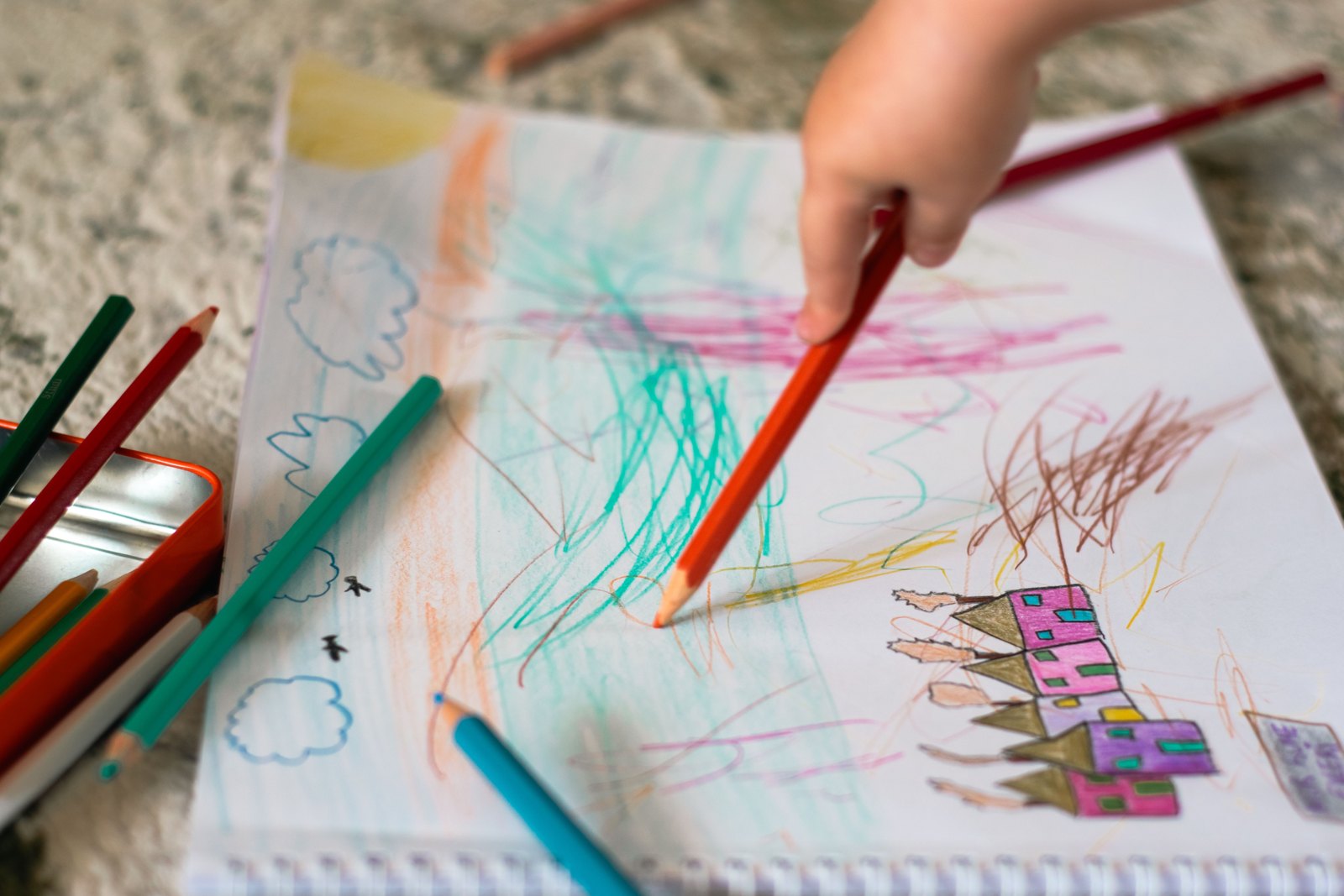
Photo: Çiğdem Bilgin / Pexels. Used under the Pexels License. Illustrative stock photography; people shown are not endorsing the book.
You do not need drawing software to make a coloring page. A circle can become a bear face, a long oval can become a fish, and a loop can become a pretend creature. The useful design choices are clear boundaries and enough room for the child’s preferred coloring marks.
Start with three large shapes
Draw a circle, oval, and rounded rectangle on separate parts of blank paper. Ask which one should become an animal. Keep the others as practice or turn them into scenery. This gives the child a starting point without making them choose from an enormous list.
Use your own shapes and ideas. Do not trace a purchased book page or an online illustration and call the result original. A homemade page can be simple precisely because it does not need to reproduce a particular artist’s style.
Close the areas you want to color
If you want a clear coloring area, connect the outline where it meets itself. Leave broad spaces for a body, face, or background. Small details can be drawn beside the main shape rather than crowded inside it.
| Starting shape | Add | Leave space for |
|---|---|---|
| Circle | Two ears and a face. | A scarf or background. |
| Oval | A tail and one eye. | Water marks beside it. |
| Rounded rectangle | A head and broad feet. | A pretend doorway. |
The table is a drawing recipe, not a rule about real animal anatomy. Let the child decide whether the result is a real animal or an imaginary one.
Test the outline before making the final page
- Make a short line with the chosen drawing tool on an offcut.
- Allow it to dry if needed.
- Try the coloring tool across part of the line.
- Check whether the outline smears or becomes hard to see.
- Choose a different combination if the test is unsatisfactory.
A pen that works with pencils may behave differently with wet paint. Test the exact tools on the actual paper instead of assuming every black line is permanent or compatible.
Give the child a design brief
Ask “Would you like a big animal with one cloud, or two small animals with a path?” Then draw the selected version. If the child changes their mind, add the new idea on another sheet rather than squeezing everything into the first picture.
Reverse the roles
Invite the child to draw a coloring page for you. Let them explain the available areas and decide whether you can add new details. Ask before coloring across an outline they consider important. This gives the child a chance to be the page designer rather than always following an adult’s setup.
If they prefer scribbles or open lines, those can be the artwork. You can color around them or make a separate closed-shape page. Do not redraw their marks without permission just to make the sheet look more like a commercial book.
Keep a useful version
Save the original if the child wants to use it again. Any scanning or duplication should use artwork you own or have permission to reproduce. A small folder of household-made designs can sit beside a paperback, offering a choice between a ready-made picture and a page created together.
Frequently asked questions
Do I need a thick black marker?
No. Use a drawing tool that makes a clear line on your paper and passes your small compatibility test. A pencil outline can be enough.
Can we make pages digitally?
Yes, but this activity does not require software. Use your own artwork and review any app’s current permissions and costs before introducing it.
Choose your next small activity
Explore the Baby Animals paperback
For a separate coloring choice, Wild Little Wonders: Baby Animals is an English paperback for ages 4–8 with 40 baby animals, large coloring pages, and short animal facts. Preview real inside pages and check the book details, then view the paperback on Amazon for current price and delivery. The activities above also work with your own original drawings; no purchase is needed.
Explore Baby Animals
See the actual inside pages before deciding whether the book fits your child.
Check the paperback on Amazon